
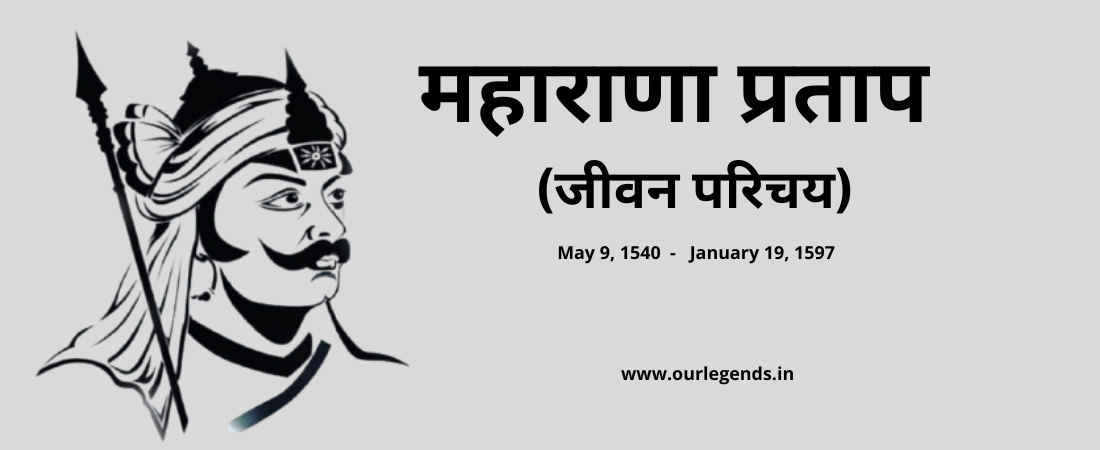
Maharana Pratap:
Maharana Pratap Singh Sisodia is remembered as one of the greatest rulers in the history of India during medieval times. He belonged to the famous Sisodia Rajput family from Mewar, making him the 13th King of Mewar – in what is now Rajasthan – a region of India. Maharana Pratap is viewed by many as a global icon of bravery, loyalty to his country, pride and military brilliance. In the 16th century, most Rajput kings had surrendered to the expanding Mughal Empire under Emperor Akbar and had signed treaties or become subject to Mughals. Maharana Pratap was one man who, through his bravery and unyielding spirit, defied the Mughals and resisted their authority. During his life, he fought for the freedom of his country, living a harsh life in the mountainous terrain located in the Aravalli mountains instead of choosing a life of submission. He dedicated the rest of his life to defending his country from outside forces, and died fighting for its freedom.
Maharana Pratap Early Life:
On May 9, 1540, Maharana Pratap was born into the majestic Kumbhalgarh Fort, situated in the kingdom of Mewar. The son of Maharana Udai Singh II and Maharani Jaiwanta Bai, he was the firstborn male. Mewar was undergoing an upheaval of geopolitical changes as well as facing many military threats at the time of Maharana Pratap’s birth. Pratap’s childhood nickname was “Kika”, which he was given by his family and local Tribal people.
Rajasthan is a culturally vibrant place with a focus on being warriors; therefore, Maharana Pratap’s upbringing was much different than that of many other princes who were sheltered. He travelled extensively throughout Mewar to the many rural and hilly regions, allowing him to feel a close kinship with the native Tribal people called Bhils, who taught him how to survive in the thick forests of the area. This relationship would prove to be one of his greatest advantages during his guerrilla warfare campaign against the Mughal Empire’s armies. Maharana Pratap was raised in accordance with traditional Rajput morals and ethics, which instilled a strong sense of duty to his subjects and loyalty to his kingdom.
Maharana Pratap Education:
The vastness and complexity of Prince Pratap’s education seem tailor-made to create a warrior king that would be one for the ages. He received traditional teachings of reading-writing plus a solid foundation in administration and governance at the hands of scholar courtiers. But, his real focus was military arts (Shastra Vidya).
Pratap achieved proficiency across all aspects of military art as practiced in the medieval era through extensive training in the following domains:
Combat Skills and Weapon Systems: Training for Pratap included extensive refinement of several martial arts including both long range weapons, i.e., sword, spear; and hand-to-hand combat.
Archery: He had an impressive level of skill with archery. He could accurately hit a target while shooting at a moving object.
Cavalry Skills: He mastered both horses and elephants while using them in battle, creating the conditions and techniques necessary to develop a telepathic connection with his legendary warhorse Chetak.
Geography Related to Warfare: A key component of his educational process related to the geography of the Aravalli Mountain range. He studied the Aravalli range in depth understanding its different terrains, hidden pathways and location of water, which he later used to develop new strategies to defeat large armies in mountain warfare.
Maharana Pratap Family:
Maharana Pratap hailed from the renowned Guhila-Sisodia lineage of Mewar. This noble family is known for producing many brave, heroic warriors such as the legendary Rana Sanga and Kumbha.
Father – Maharana Udai Singh II, the guy who created Udaipur—the city of lakes—after the eastern part of Mewar fell to the enemy.
Mother – Maharani Jaiwanta Bai, who was strong and independent, she was the daughter of Akheraj Songara of Jalore. Jaiwanta Bai was also Maharana’s first teacher and inspired him with the epic stories of Ramayana and Mahabharata.
Brothers – Pratap had numerous younger and step-brothers, including Shakti Singh, Vikram Singh and Jagmal Singh.
The Succession Crisis – after the passing of Udai Singh II in 1572, there was a major political power struggle between the nobles/chiefs of Mewar. Due to the influence of Rani Dheerbai, Udai Singh broke with traditional custom and named his younger son Jagmal Singh as his successor rather than Maharana Pratap (due to his outstanding reputation popularity and valor). As a result, the senior nobles and chieftains (who represented the kingdom) staged a peaceful revolution in which they disavowed Jagmal Singh, and crowned Maharana Pratap as the rightful ruler of Mewar on February 28, 1572 in a ceremony at Gogunda.
Height and Physical Appearance:
Maharana Pratap was said to have a huge physique and strength based on regional legend, historical texts and hundreds of years worth of history in the form of folk songs about him. Some historians say he was approximately 7 feet 5 inches tall and weighed more than 110 kg.
Some modern historians say these numbers are simply examples of his character as a legendary figure, whereas physical evidence exists to prove otherwise – namely, the large armour still displayed at the City Palace Museum in Udaipur, which provide evidence of Maharana Pratap’s immense physical strength. His actual armour weighed approximately as follows:
War Gear Item Approximate Historic Weight
Body Armor (Kavach) ~72 kg
Two Spears (Bhala) ~80 kg
Personal Swords & Shield Massively weighted for dual wielding
Total Combat Weight Over 200 kg of equipment carried simultaneously
This physical configuration allowed him to overpower multiple opponents simultaneously on active battlefields, cementing his reputation as one of the most physically imposing warriors of the era.
Maharana Pratap Spouse:
Maharana Pratap took 11 wives over his life in order to solidify political alliances across Rajputana and create internal stability.
Ajabde of Bijolia was the first and most significant wife of Maharana Pratap, marrying him in 1557; she was a confidant, trusted advisor, and companion to Maharana Pratap through all periods of his life (i.e., royal life and during periods he was living in extreme poverty in remote parts of the mountains). Maharana Pratap had two sons by Ajabde, his first being Amar Singh (heir to the throne) born in 1559, and the second, Bhagwan Das, who was born later. Maharana Pratap also had multiple additional wives, primarily to create political alliances with Rajput clans (and thus create regional unity against outside forces), for a total of 17 sons and many daughters.
Maharana Pratap Jayanti:
Maharana Pratap Jayanti, the anniversary of the birth of this historic figure, is celebrated throughout India each year on May 9th according to the solar calendar, and is often a public holiday in states such as Rajasthan, Haryana, and Himachal Pradesh. The traditional way of celebrating his birthday used to follow the lunar calendar system based on the lunation of the month of Jyeshtha.
In Kumbhalgarh Fort (where he was born), large processions take place both there and throughout Udaipur on this day. Flower decorations are placed on his statue (as well as on his famous horse Chetak), and traditional folk songs expressing his courage are performed.
Muglo Se Yudh (Wars with the Mughals):
Maharana Pratap’s reign was defined by his unwavering military opposition to the Mughal Empire, which had ambitions of ruling all of India; to achieve this end, ruling Mewar was critical because it controlled the significant trade and military routes to the lucrative ports of Gujarat. From 1573 to 1575, Emperor Akbar dispatched four large diplomatic missions, each led by a high-ranking representative—such as Jalal Khan, Raja Man Singh, Raja Bhagwant Das, and Todar Mal—attempting to persuade Maharana Pratap to accept Mughal suzerainty. Although he welcomed these representatives, Maharana Pratap refused to submit to Akbar personally, an act that inevitably resulted in one of the largest military conflicts.
The Battle of Haldighati (1576):
The Battle of Haldighati occurred on June 18, 1576 in a narrow, yellow-soiled mountain pass…close to Rajsamand. Maharana Pratap’s army consisted of approximately 3,000 cavalry and 400 Bhil archers, while Raja Man Singh I of Amber commanded an enormous Mughal military with between 5,000 to 10,000 soldiers.
This battle was incredibly fierce and because Maharana felt greatly outnumbered, he charged toward Raja Man Singh, who was on a very tall war elephant, with his stallion, Chetak. Chetak bravely walked on his two front legs up the trunk of the elephant, allowing Maharana Pratap to throw his spear at Raja Man Singh as he bowed out and survived. However, Chetak injured his leg as a result when Chetak hit this concealed weapon on the elephant’s trunk.
As Maharana was besieged, his valiant commander Jhala Maan took the crown of Mewar and wore it, throwing the enemy off track. During the battle, Jhala Maan fought bravely until he was killed, allowing Maharana Pratap, who was badly wounded, to retreat into the mountains. Chetak, the horse of Maharana Pratap, ran for a long distance despite having had his leg cut off, leapt across a 25-foot wide mountain stream in order to save his master, and died shortly thereafter. The battle had been a defeat for the Mughals; although they held the battlefield, they had absolutely failed to capture or kill Maharana Pratap, leaving the spirit of Mewar intact.
Exile and Guerrilla Warfare:
After his defeat at Haldighati, Akbar continued to pursue Maharana Pratap with several campaigns. However, Pratap was able to elude the Mughal forces by retreating into the hills of the Aravalli mountain range. A vow he made to himself during his time of exile was that he would sleep on the ground and eat only off of leaf plates until the day when Chittor would be liberated. During this very difficult time, Bhama Shah, a wealthy minister donated his entire fortune to help support Pratap’s army. This large donation of money allowed Pratap to provide for an army of 25,000 men for a period of 12 years. Pratap also received assistance from the Bhil people who lived in grants throughout the area; thus, he abandoned all forms of traditional warfare and developed a more unconventional form of military operations, which included surprise attacks at night, ambushes, and disruption of supply lines against the occupying Mughal army.
The Battle of Dewair (1582):
In 1582, Maharana Pratap launched an extraordinary coordinated counter-offensive that is widely regarded by historians as one of great skill and ability when he invaded Dewair the Mughal’s main base in the area (Dewair was located on the southeastern edge of Mewar) and attacked the fortification surrounding it, overrunning it in the process of freeing Dewair from Mughal control, and displayed great bravery and courage through his son (Amar Singh), while also demonstrating a level of detail in plan execution, such as having a coordinated effort to remove all the surplus animals and military goods from web and preparation to destroy all positions that were formerly manned by Mughals.
The successful capture and victory of Dewair led Maharana Pratap to go on to take control (within a short time) of 36 other Mughal’s outposts (manned military facilities) throughout Mewars’ territory and begin systematically driving out Akbar’s military forces from Mewars’ territory. Akbar eventually ceased all military operations against Mewar and focused on rebellions in the Punjab and Afghanistan, providing Maharana Pratap a window of opportunity to recover almost all of Mewar (including Udaipur, Kumbalgarh, and Gogunda) barring the Chittorgarh fort.
Maharana Pratap Death:
Maharana Pratap re-conquered his territories and established a temporary new capital at Chavand after which he spent his final years rebuilding the administration and supporting the arts and literature.
His death was not at the hands of his opponents but rather the result of a hunting accident. In the early morning of January 19, 1597, after successfully using a heavy composite bow for a number of hours while hunting, Maharana Pratap suffered a severe internal injury to his chest and abdomen from trying to pull the bow string back with more than 60 kg of resistance to fully draw the string. He never fully recovered from this injury and died at the age of 56. Legend has it that upon hearing about Maharana Pratap’s death, even Emperor Akbar cried because he was so moved and impressed by the strength of character and great courage exhibited by such a person as his greatest enemy. Today, at Chavand there is a magnificent eight-sided marble monument (chhatri) built in honour of Maharana Pratap’s funeral pyre.
Conclusion:
Maharana Pratap’s life serves as an incredible example of the power of courage and determination in overcoming the most powerful empires in history. He was not motivated by acquiring territory or establishing a personal dynasty; rather, he fought to preserve the cultural freedoms and dignity of his people. In a time where compromise was commonplace, he chose instead an unending struggle. To this day, he remains an immortal symbol of patriotism through poetry and folklore, as well as by residing in the hearts of millions of people across the globe. His example continues to resonate with each new generation as a reminder that regardless of how insurmountable the obstacles may seem, you should never compromise your honour or your freedom.