
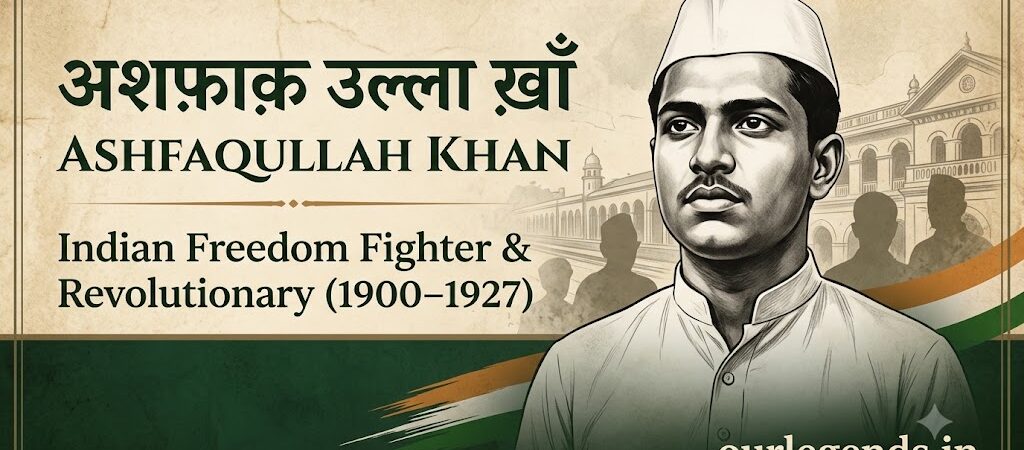
Ashfaqulla Khan: A Brave Revolutionary of India
Ashaf Kulla Khan was one of the bravest freedom fighters in India’s struggle for independence. He was born and converted to a Muslim family on 22 October 1900 in Shahjahanpur, Uttar Pradesh. When India was under British rule and people were agitating for independence, Ashfaqullah Khan chose the path of revolution. He firmly believed that independence was due to every Indian and that men of different religious communities needed to prepare for a united struggle against foreign rule .
He is remembered for taking part in the Kakori train robbery of 1925, as a member of the Hindustan Socialist Republicans (HSRA), and as a close friend of progressive Rom Prasad Bismil Though he lived a fast life, he remained brave and devoted to his u. S.S. A ., and reflected the freedom movement during the records of India.
Family and Early Life
Shahjahanpur was where Ashfaqulla Khan was born. He was the child of Shafiqullah Khan, a person of good reputation, and his mother was Mazhar-un-Nisa Begum who greatly contributed to his upbringing. He lived in an environment that put a lot of value on learning, honor, and bravery.
Ashfaqulla was influenced by the situation in India during British domination since childhood. He saw how the Indians were discriminated against and oppressed in a political sense. All of this gradually made him want India to get its independence and the end of British rule.
He was also a poet and he shared with many revolutionaries of his generation the passion for using poetry as a means of expressing love for the country, courage, and patriotism.
Entry into the Freedom Struggle
During the early years of his life, Ashfaqulla Khan engaged in revolutionary activities. His acquaintance with Ram Prasad Bismil, a famous revolutionary hailing from Shahjahanpur, created a bond that became a fine example of Hindu-Muslim unity during the fight for freedom. Despite the fact that Ashfaqulla belonged to the Islamic faith while Bismil was a Hindu, the friendship of both of them became an example of communal harmony. They believed that India’s independence would require courage, training, and sacrifice. The association of Ashfaqulla Khan with the Hindustan Republican Association made him a partner in this revolutionary organization, which was aimed at establishing an independent republic in India.
The HRA revolutionaries required funds, arms, and other materials in order to execute their mission. Government of India kept a close watch on such groups, making it very difficult for revolutionaries to raise money.
Contribution to the Freedom Struggle
Ashfaqullah Khan’s greatest contribution in the freedom struggle is his work in revolutionary action against British rule in India. He not only transformed himself into an agitator in opposition to the colonial government; He gets ready to threaten his personal existence for India.
According to him , U S.S. It belonged to all Indians irrespective of their creed, caste or community. His friendship with Ram Prasad Bismil demonstrated this idea in action and therefore opposed the divide created by colonialism/insurgency.
Ashfaqullah Khan did his job as a progressive way of being in the right place at the right time. He traveled, worked undercover, and risked much for his job.
The Kakori Train Action
Ashfaqulla Khan is best known for the Kakori Train Robbery, which took place on August 9, 1925, in Kakori, not far from Lucknow, where the revolutionaries planned to rob the train carrying government money.
They did not intend to steal the money for their own use. The entire purpose of the operation was to garner funds for their revolutionary organization and the struggle against the British government.
Ashfaqulla Khan took part in the robbery with his fellow revolutionaries Ram Prasad Bismil, Rajendra Lahiri, Sachindra Nath Bakshi, and others.
While the robbery was planned meticulously, it attracted the attention of the British authorities who conducted a massive investigation.
Many of the people associated with the Kakori case were arrested by the British police. They regarded the incident as a severe challenge to colonial might, and as a result, the Kakori Conspiracy Case has become one of the most well-known revolutionary trials of that time.
Ashfaqulla Khan and Ram Prasad Bismil
The friendship between Ashfaqulla Khan and Ram Prasad Bismil is significant in ways that deserve special mention. This relationship is an example of national unity.
When religious differences could have fuelled strife, Bismil and Ashfaqulla showed what it meant to stand united for the independence of India.
Their friendship showed that people from various communities could rally together to achieve one national goal. Even today, their lives symbolize the idea of collective struggle for India’s freedom.
Was Ashfaqulla Khan Connected with the Chauri Chaura Incident?
The Chauri Chaura episode occurred on February 4, 1922, which occurred in present-day Uttar Pradesh in the Gorakhpur district. This incident happened amid a protest and a clash between the protestors and several police forces, which led to the burning of a police station and death of police officials.
The event played a major role in the national struggle in India since Mahatma Gandhi, in the wake of the violence, called off the Non-Cooperation Movement.
However, it should be mentioned that Ashfaqulla Khan was not involved in the Chauri Chaura incident. In fact, this incident took place in 1922, while Ashfaqulla Khan’s revolutionary activities took place later.
Hence, it should be mentioned that Chauri Chaura should be evaluated in the context of freedom struggle, not as of the event in which Ashfaqulla Khan took part directly.
Arrest and Final Days
The occurrence of the Kakori incident led the British to make a widespread attempt to catch the freedom fighters in question. Ashfaqulla Khan had, for some time, been able to keep himself hidden.
He tried to exit India and was searching for an opportunity to go to a different country to enable him to carry on with his revolutionary activities from there. However, ultimately, he was sold out by the man he trusted, and arrested in Delhi in the year 1926.
After his arrest, he was charged in relation to the Kakori incident. He was condemned to death by the British authorities.
Nonetheless, even after being convicted to death, Ashfaqulla Khan showed great courage. He continued to be true to his beliefs and did not regret devoting himself to India’s independence.
Death and Martyrdom
Ashafqullah Khan was hanged in December 1927 in the Faizabad Jail which is currently set up in the Ayodhya district of Uttar Pradesh. He turns out to be only 27 years old at the time of the murder.
The sidelining of the alternative Kakori revolutionaries by Ashaf Kulla Khan had a profound impact on the country.
Ram Prasad Bismil, Rajendra Lahiri and Roshan Singh were additionally hanged as a result of the Kakori case.
With the death of Ashfaqullah Khan, he grew up as a reflection of youthful heroism and sacrifice.
Legacy
The legacy left by Ashfaqulla Khan goes far beyond the events linked to the Kakori action. He symbolizes feelings like bravery, devotion, sacrifice, and oneness.
A very valuable lesson learned from his life is that Hindu-Muslim unity was a significant factor in the Indian independence movement. The friendship of Ashfaqulla Khan and Ram Prasad Bismil serves as a proof of the fact that the movement was endorsed by people of very different religious and social backgrounds.
His life proves that the youth had played an important role in India’s struggle. He was very young and only in his twenties when he became involved in revolutionary activities. The passion of Ashfaqulla Khan shows that the youth were strongly against British power.
His poems and writings add to his image as a fighter, who is courageous and yet sensitive. He was not only a fighter- he was a patriot in love with his country and friendship, who made a great deal for the freedom of his country.
Conclusion
Ashfaqulla Khan is a well-known person in the history of India’s freedom movement. His life demonstrates the courage with which he lived. He started out from Shahjahanpur before he earned his name in the Hindustan Republican Association. He participated in the Kakori Train Action and later on was arrested and executed.
Ashfaqulla Khan’s life story is a reminder that different individuals and communities took part in India’s struggle to gain freedom from the British.
He sacrificed his life in the pursuit of this freedom on 19 December 1927. His bonding with Ram Prasad Bismil, the revolutionary activities that he took part in, his daring attitude towards the British officials and his willingness to face death has made him an important part of India’s freedom movement story.
Ashfaqulla Khan is considered a symbol of love for one’s country, sacrifice, bravery, and unity. Those who learn his life understood that real love for the country should be demonstrated by more than just words.