Lokmanya Tilak (Bal Gangadhar Tilak):
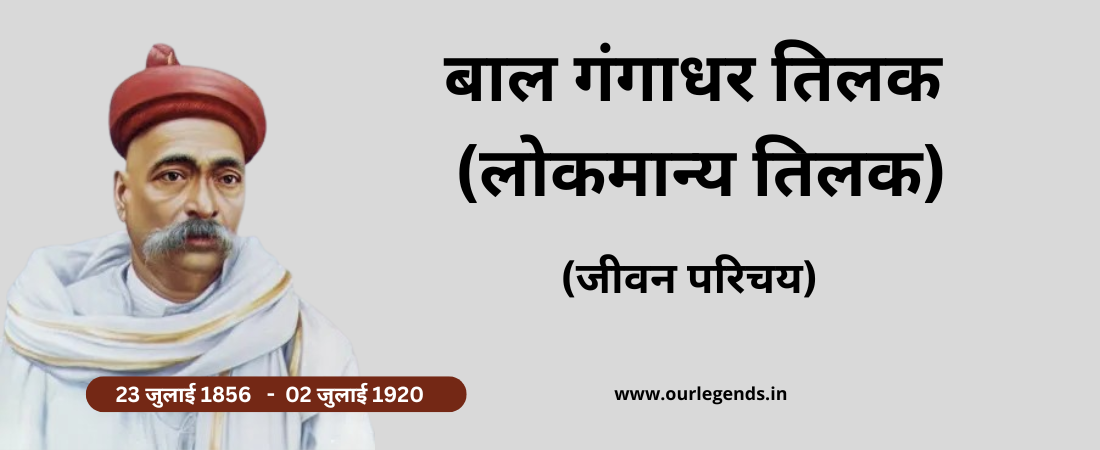
Bal Gangadhar Tilak, Keshav Gangadhar Tilak’s birth name, was one of the great architects of the modern day of India and served as a monumental pillar for India’s independence movement. He was referred to as “The Father of the Indian Unrest” by colonial British authorities and as “The Father of modern India” by Mahatma Gandhi. Tilak transformed what had once been an exclusive discussion among a limited class of people into a mass movement of the people to achieve freedom from British rule.
Millions of followers have given him the title “Lokmanya,” meaning “the people’s accepted leader,” because he dared to speak for and defend their rights. Even prior to Mahatma Gandhi, who became the leader of India’s independence movement, Tilak created a spirit of national identity and pride for India, gave confidence and hope for India to obtain freedom through the establishment of a national consciousness and psyche, and he created a national consciousness throughout the entire Indian subcontinent. He was a dynamic individual who was able to bridge different fields, such as academia, journalism, social reform, and aggressive political activism, with equal degrees of ability.
Bal Gangadhar Tilak Birth and Birth Place:
On July 23, 1856, Keshav Gangadhar Tilak was born into a traditional Marathi Brahmin family in the coastal town of Ratnagiri, in Maharashtra (then Bombay Presidency) on the konkan coast of the Arabian Sea with its beautiful but rugged backdrop providing the setting for Keshav’s earliest childhood and for his in-depth cultural background and up-bringing steeped in tradition and values and knowledge of Sanskrit. Although at birth his name was Keshav, his family affectionately called him “Bal” and this was his name throughout his life in the public eye. Around the age of 10, Bal’s family moved from Ratnagiri to Poona (now Pune), a city that served as an epicenter of intellectual and cultural activity for Maharashtra and which would serve as the main battleground for Tilak’s political and social work for the rest of his life.
Bal Gangadhar Tilak Education:
Tilak was an intellectually gifted child with an innate ability to think analytically about complex subjects from an early age. He received rigorous training from his father — a highly respected teacher and grammarian who taught him at home before sending him off to school. Because of this training, he was able to attain a comprehensive level of proficiency in both the Sanskrit language and the traditional Hindu scriptures.
After graduating from college, Tilak waited for Deccan College (located in India’s Gift Day Pune), where he received a Bachelor of Arts degree in Mathematics and Sanskrit in 1876. Not only did he excel academically while attending school, he refused to go straight into the lucrative business world; As a result, he agreed to attend law school for you to study the British colonial penal system more speculatively. He holds an L.L.B. 1879 Diploma from Government Law College, Bombay (Gift Day Mumbai).
Tilak really thought that the educational system created by Lord Macaulay was only intended to provide the British Empire with a source of labor. In order to change that and to provide an education based on nationalistic values to Indian youth, Tilak, along with his friends from college (Gopal Ganesh Agarkar, Vishnushastri Chiplunkar) opened the New English School in 1880. Through that school, they were able to create the Deccan Education Society in 1884 and Ferguson College in 1885. At Ferguson College, Tilak volunteered his time to teach Maths.
Bal Gangadhar Tilak Family:
Gangadhar Ramachandra Tilak was born to Parvatibai Gangadhar Tilak and Gangadhar Ramachandra Tilak. Although he was only a child (nine) when his mother died; she had a profound effect on him; at the same time, he was left an orphan (when he turned sixteen) because of two different deaths of his parents (first mother then father); this left him having had to build his own character very soon after his mother’s death.
He was married in 1871 as a sixteen-year-old boy to a young girl named Tapibai. Then, when they were married according to customary requirements, she acquired the name Satyabhamabai. She remained a faithful and strong wife by enduring extreme physical and financial stress through all of her husband’s political career during which he spent long amounts of time in jail due to his involvement in his country’s political revolution. The couple had three sons; one son (Rambhau Balwant Tilak), and two sons (Vishwanath Balwant, Shridhar Balwant) were raised with their three daughters. The legacy of their family will continue as the descendants of Tilak have continued his family tradition of being educated and aware socially, and will continue to serve their country through both public service and journalism in Maharashtra.
Bal Gangadhar Tilak Role in Freedom Fighting:
The Indian national movement was altered in a dramatic way with the entry of Tilak into politics. Although he joined the Indian National Congress (INC) in 1890, his experience with its more moderate political structure, which advocated for “parliamentary, begging and complaining as methods of gaining independence”, quickly disillusioned him. He did not view these constitutional approaches as having been successful against the intransigence of the colonial empire. Along with Lala Lajpat Rai (Punjab) and Bipin Chandra Pal (Bengal), he established the radical triumvirate of Lal-Bal-Pal.
Bal Gangadhar Tilak Journalism as a Weapon:
Tilak understood that real influence was in giving power to the masses, and he launched two major nationalist newspapers in 1881:
• Kesari (The Lion), was published for the mass audience in Marathi.
• The Mahratta, written for an educated reader, used English as its language.
The economic exploitation and tyrannical rule of the British were regularly depicted in Tilak’s articles. Tilak rallied the public’s anger over the British mismanagement with his strong editorials appearing about the Pune plague in 1897 and the subsequent Famine of 1897.
Cultural Nationalism and the Masses
Tilak creatively reinstated two community festivals as venues for expressing nationalistic solidarity between educated and uneducated classes:
- Ganesh Utsav – changed from a private home ritual into a large public festival where all castes could come together, listen to patriotic speechs and sing nationalist songs;
- Shivaji Jayanti – to recognise and celebrate Marathi warrior king Chhatrapati Shivaji Maharaj’s achievements in instilling courage among youth to fight against oppression.
Swadeshi, Boycott, and the Split:
After Lord Curzon partitioned the Bengal Province in 1905 which caused a lot of contention, Tilak took a leading role in nationalizing both the Swadeshi Movement and the Boycott Movement. In this movement he outlined a four-part program of Swaraj (self-rule), Swadeshi (use of Indian products), Boycott (refusal to use British products and institutions), and National Education. His extreme demands created an ideological divide in the Congress party, and a split occurred at the Congress party’s 1907 Surat session when it split into the Extremist or Garam Dal faction (Tilak-led) and the Moderate or Narmal Dal faction (Gokhale-led).
Imprisonment and the Home Rule League:
In 1908 Tilak was charged with sedition after defending Bengali revolutionaries through his newspaper Kesari. He received a six-year prison sentence and was sent to Mandalay Prison in Burma (Myanmar) as a prisoner of war. When he was released in 1914 he immediately returned to politics with renewed energy. Aware of the global affairs of the time due to World War I, he joined forces with British political leader Annie Besant to create the All India Home Rule League in 1916 asking for dominion status for India. He was instrumental in arranging the Lucknow Pact of 1916 between himself and Muhammad Ali Jinnah, building a temporary, but productive, connection between Hindus and Muslims in the nationalist movement.
Tilak Slogan:
Swaraji has been a powerful political rallying cry since Lokmanya Tilak issued his famous declaration to have “Swaraji is my birthright, I will have it” in the late 19th century. This slogan, although an assertion of political right to rule over one’s own country, serves as a philosophical statement of a person’s inherent dignity as described here.
Before Tilak’s bold assertion of Swaraji, the dominant discourse in India was to seek limited constitutional concessions and administrative reforms from Great Britain. By framing Swaraji as an inherent” birthright,” Tilak reframed the discourse by declaring that one does not need to seek colonial sanction in order to be free. His powerful yet simple statement inspired millions of people all over India and has had a lasting effect on our emotional state and created a foundation for all subsequent movements led by Gandhi, such as the mass satyagrahas.
Bal Gangadhar Tilak Written Books:
Besides being a strong and tireless political activist, Tilak became a scholar, writer, researcher and philosopher. Even when playing limited English ways in isolation, Tilak tolerated the pursuit of his lofty goals without interruption. His writings show an extraordinary breadth of expertise in astronomy, Vedic mathematics, records, and metaphysics.
| Book Title | Language | Core Theme / Concept |
| The Orion, or Researches into the Antiquity of the Vedas (1893) | English | An astronomical study of Vedic texts, using planetary positions to date the Vedas back to 4000 BCE. |
| The Arctic Home in the Vedas (1903) | English | A unique historical and geological theory arguing that the primordial Aryan home lay in the Arctic regions before the Ice Age. |
| Shrimadh Bhagavad Gita Rahasya (1915) | Marathi | Written during his imprisonment in Mandalay; a groundbreaking commentary on the Gita emphasizing Karma Yoga (the philosophy of selfless action) over renunciation. |
Lokmanya Tilak Terminus:
Tilak’s legacy continues to grow in present-day India. The Lokmanya Tilak Terminal (LTT), within Mumbai’s Kurla district, is the most visible reminder of Tilak’s legacy.
Originally called Kurla Terminus when it started operations in 1991, Chhatrapati Shivaji Maharaj Terminus (CSMT) was renamed Lokmanya Tilak Terminus in 1999 due to an initiative taken by the Greater Mumbai Municipal Corporation with the help of the Ministry of Home Affairs, which is now operated by LTT Traffic in Mumbai. Railway District; All long-distance, unique and ultrafast proposals originating from or terminating from LTT connect Mumbai with the northern, upper and southern states of India. The vast, revamped terminal facilities are a daily testament to a great leader who spent countless hours in Mumbai and Pune pursuing his revolutionary objectives.
Bal Gangadhar Tilak Death:
Tilak suffered greatly from the physical toll of years of constant political fighting, hard time in prison, and other personal tragedies by 1920. His health became worse in July 1920 when he developed a very severe case of pneumonia. Lokmanya Bal Gangadhar Tilak died in Bombay on August 1, 1920, at the age of 64.
His death represents the final end of the “Tilak Era” in Indian politics. Over one million people participated in his funeral procession in Bombay, making it the largest funeral procession in Indian history and included leaders from all walks of life and every political and religious persuasion. Strangely enough, August 1, 1920 was also the very same day that Mahatma Gandhi was scheduled to officially launch the historic Non-Cooperation Movement; thus, the torch of the freedom struggle was passed from Tilak to Gandhi on that day.
Lokmanya Tilak Jayanti:
On this date in 1954, July 23rd each year marks the birth of Lokmanya Tilak, and is celebrated throughout India. Observations of July 23rd are particularly strong in schools, colleges, as well as other administrative bodies, throughout Maharashtra and other parts of India. At various locations, floral tributes are placed at the foot of statues of Lokmanya Tilak. Seminars are held to emphasize Lokmanya Tilak’s philosophies of Swadeshi (self-reliance) and National Education. The birth anniversary of Lokmanya Tilak reminds people each year of the brave leader who dedicated his life to liberating India from foreign conquest through force and did so while displaying an unconditional love for his homeland.