Introduction:
Tiruppur Kumaran Biography tells the story of a young Indian freedom fighter who gave his life for the honour of the national flag. He is remembered as “Kodi Kaatha Kumaran,” a Tamil phrase meaning “Kumaran who protected the flag.” His story is not simply about one freedom fighter. It is about courage, sacrifice, patriotism, and the determination of ordinary Indians who stood against British rule.
Born into a modest family in Tamil Nadu, Kumaran became involved in India’s freedom movement at a young age. He worked as a weaver and later became active in nationalist activities. He also helped organise young people through the Desa Bandhu Youth Association. His dedication eventually led him to participate in protests against British rule.
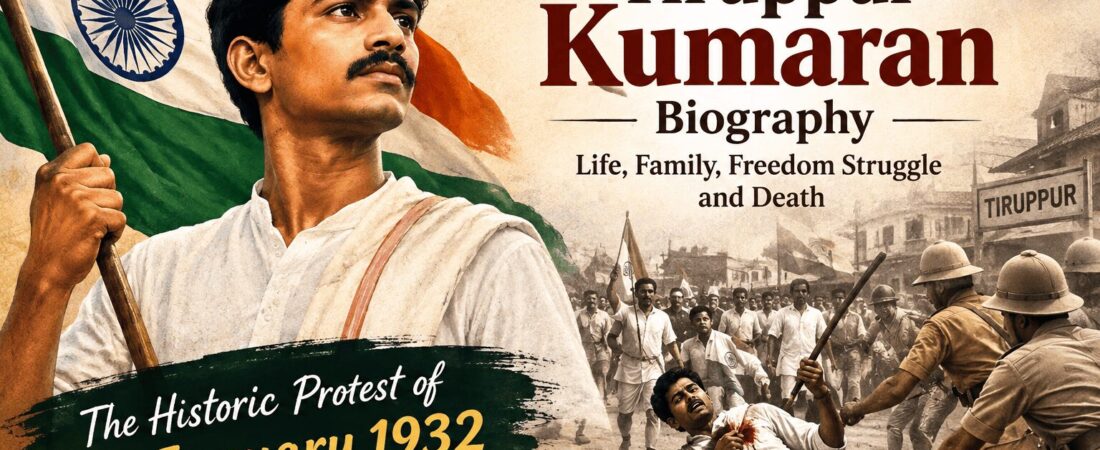
The most defining moment of his life came on 11 January 1932, when a protest in Tiruppur was met with a police lathi charge. Kumaran was severely injured, but even as he collapsed, he refused to let the national flag fall to the ground. He succumbed to his injuries on the subsequent day.
Quick Details About Tiruppur Kumaran
| Detail | Information |
| Full Name | O. K. S. R. Kumaraswamy Mudaliar |
| Popular Name | Tiruppur Kumaran |
| Known As | Kodi Kaatha Kumaran |
| Born | 4 October 1904 |
| Birthplace | Chennimalai, Tamil Nadu |
| Father | Nachimuthu Mudaliar |
| Mother | Karuppayi Ammal |
| Wife | Ramayi |
| Occupation | Weaver |
| Organisation | Desa Bandhu Youth Association |
| Movement | Indian Independence Movement |
| Major Role | Participation in nationalist protests |
| Date of Martyrdom | 12 January 1932 |
| Age at Death | About 27 years |
According to government records, Kumaran participated in the Civil Disobedience Movement and became associated with youth mobilisation during the freedom struggle.
Early Life and Childhood
Tiruppur Kumaran was born on the 4th of October in the year 1904 in Chennimalai, in the current state of Tamil Nadu. His family was not very well off and his family’s profession was weaving.
His father was Nachimuthu Mudaliar, and his mother was Karuppayi Ammal. Due to his family’s economic conditions, Kumaran could not study for long and started working early.
Thus, Kumaran’s childhood was completely different from the childhood of later prominent political personalities. Kumaran belonged to a working-class family and faced worldly problems.
Later, Kumaran moved to Tiruppur, which became closely associated with his later name. Kumaran was a professional weaver but at the same time was increasingly drawn toward political activities.
Family and Personal Life
Kumaran was born in a humble family met with economic hardships. His parents were compelled to exert considerable effort in order to maintain financial stability and meet their essential expenses. The childhood experiences helped him shape his views on the importance of working hard.
Historical records document the fact that he was married to Ramayi at a very young age. His family also had to face numerous problems similar to the ones all families of that time suffered from.
His family was worried about him because of his participation in the freedom struggle. He could face numerous problems while taking part in actions held against British colonial rule, which included the arrest and violence that activists might experience.
Kumaran took risks but did not abandon his participation in the struggle for the freedom of his country while being responsible for his family.
How Tiruppur Kumaran Joined the Freedom Movement
During the 1920s, the phenomenon of Indian nationalism was spreading across India quite rapidly. The ideologies of Swadeshi, non-cooperation, civil disobedience and national unity, which became hugely popular due to Mahatma Gandhi’s messages, captured the minds of people belonging to various sectors of society.
Kumaran became part of this great movement too. He started his involvement from the local level and began to work with youth.
This way, he established the Desa Bandhu Youth Society, which allowed youth to take part in nationalist activities. The role of Kumaran was vital because the freedom movement depended on ordinary people’s involvement in organizing meetings, participating in processions, raising awareness amongst the masses and fighting against colonial laws.
Later on, Kumaran engaged in the Civil Disobedience movement. The fact that he was involved in the struggle proves that this fight for freedom was not limited to popular leaders of the nation.
Role in India’s Freedom Struggle
The significance of Tiruppur Kumaran stems from his bravery and sacrifice.
He was involved in activities against the British government, which was trying to bring an end to nationalistic protests. Protests were risky in that they could lead to arrests, but many Indians soldiered on.
Kumaran sought to motivate young people to partake in patriotic movements. He helped establish a group of young active citizens through the Desa Bandhu Youth Association.
His participation in the protests of 1932 was very impactful. The Civil Disobedience Movement resulted in many protests across India.
Kumaran was involved in the protests in rational city. He took part in a procession, where people carried the flag of the nation and shouted patriotic slogans.
The Historic Protest of 11 January 1932
On January 11, 1932, a nationalist march was organized in Tiruppur. Historical accounts state that the march started from the place called Mangala Vilas and passed through the city.
Kumaran was among the participants in the protest march. He was the one holding the tri-color flag while the participants were marching.
When the march reached the area near the police station, the police tried to block the marchers. The tension mounted, and the police were forced to resort to lathicharge.
Kumaran was among the crowd and suffered serious injuries in the incident, including major head injuries.
However, despite being hit by the police, Kumaran was still holding on to the flag and did not let it touch the ground.
The entire incident went on to become synonymous with Kumaran’s name.
Why Is Tiruppur Kumaran Called “Kodi Kaatha Kumaran”?
The name “Kodi Kaatha Kumaran” holds great significance in the annals of Tamil history. “Kodi”, which means flag in Tamil, and “Kaatha”, which relates to the idea of keeping a thing safe or protected, form the basic meaning of the name, which is taken to mean “the Kumaran who kept the flag safe”.
The name symbolizes the happenings of January 1932, when Kumaran was badly injured during a clash with the police but still managed to keep holding the Indian flag. The flag was symbolic of the fight for freedom and bore great significance politically at that time, as carrying it during demonstrations had a lot of meaning in those days in India. The fact that Kumaran refused to let the flag drop became a symbol of bravery, not due to the fact that he took part in a demonstration but rather because he fought till the end.
Tiruppur Kumaran Death: When and How Did He Die?
The date of death of Kumaran is revealed differently in a number of sources. Some sources suggest the date of Kumaran’s death to be 11 January 1932, which was also the date when the police used lathis during the protests. But the records from government archives reveal a definite chronological sequence of events. During the police action, Kumaran suffered serious injuries on 11 January 1932. He was then taken for proper treatment. However, his condition deteriorated over time.
According to the record of the Government of India, on 12 January 1932, Kumaran died at the government hospital at approximately 11 am because of the injuries received as a result of the police action. He was only around 27 years old. The given distinction is important for the purpose of presenting the information correctly. Thus, 11 January 1932 can be called the day of the protests and the day of the fatal police action, while 12 January is a more correct date of Kumaran’s death according to the government record.
Tiruppur Kumaran and Mahatma Gandhi’s Influence
The ideas of Mahatma Gandhi and the broader national movement of which he was a part shaped Kumaran’s beliefs.
During this time, the ideas of Gandhi of non-violent resistance, self-sufficiency, Swadeshi and civil disobedience became widely popular across the country.
Kumaran’s participation in the Civil Disobedience Movement reflects the influence of the greater movement.
Though he was not a national leader at this time in history, what he instilled in the common people and his local youth brigades was significant in his region.
His life also represents how liberation struggle made its way into settlements far away from political hot seats across the country!
Legacy of Tiruppur Kumaran
The legacy of Tiruppur Kumaran is still very present in Tamil Nadu.
His name has been linked with Tiruppur which is the site of his last protest.
He is viewed as a youth whose courage and selflessness during the struggle for freedom made him a source of inspiration.
The history of his contribution to the independence struggle was acknowledged by the official records of the Government of India.
Public celebrations were organised to promote his birthday and legacy.
In 2004, a commemorative postage stamp was released in honour of his centenary.
When discussing the history of the independence movement in Tamil Nadu, one cannot forget the place of his birth, Chennimalai, and Tiruppur.
What Can We Learn From Tiruppur Kumaran’s Life?
There are many lessons that can be learned from Kumaran’s story.
First of all, it shows us that age does not matter when it comes to the significance of a person’s contribution to the time period. Kumaran was only in his twenties when he became engaged in the national movement.
Second, Kumaran’s story reveals the key role of common working people in India’s struggle for freedom. He was not born into an influential family. He was a worker and a young organiser who made a conscious decision to join the revolutionary process.
Last but not least, in the end, the story vividly illustrates how important the national flag was for the revolutionaries.
Kumaran’s life ended early, but its significance has been passed down through time.
Conclusion
The Tiruppur Kumaran biography recounts the tale of a youth from Tamil Nadu whose name transformed into a symbol of bravery during the Indian freedom struggle.
He was born to a typical family in Chennimalai and opted to be a weaver before jumping into the nationalist movement. This artisan actively took part in the Civil Disobedience Movement by founding the Desa Bandhu Youth Association.
The most important event in Kumaran’s life took place on January 11th, 1932, when British police repressed the patriot’s rally in Tiruppur. His radical actions led to serious injuries by the police forces’ sticks, but he did not let go of the national flag and continued to stand strong. According to the government information, Kumaran died due to injuries inflicted during the lathi charge on January 12th, 1932, being about 27 years old at that time.
This ultimate deed granted him the everlasting name of “Kodi Kaatha Kumaran.”
The story of Kumaran is still relevant and important in history, reminding us that the independent India was not only shaped by well-known leaders, but also by millions of ordinary citizens who resisted colonial oppression and died for their ideals.