The Inspiring Journey of India’s First Woman President of the UN General Assembly
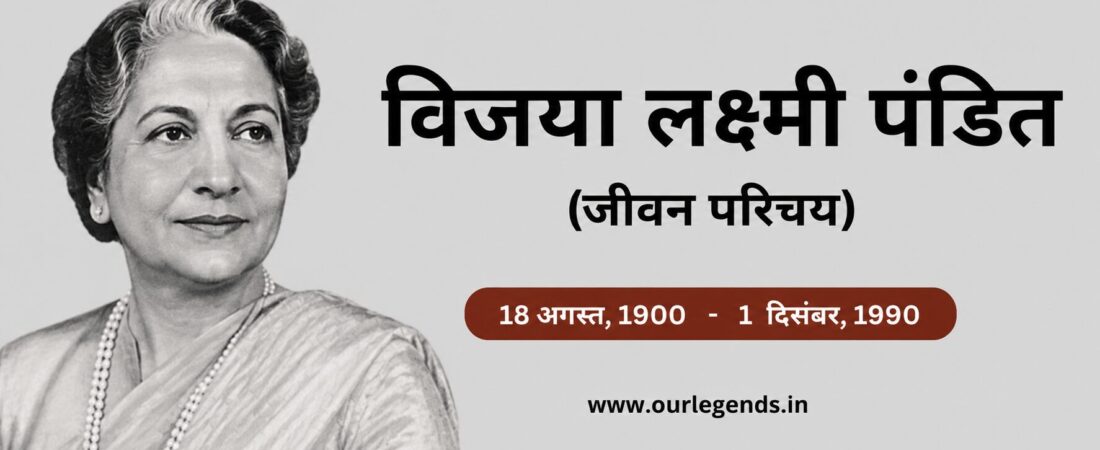
The life story of Vijayalakshmi Pandit is an inspiring story that shows the importance of diligence, bravery and determination in overcoming obstacles posed by the consumption of society and politics. She has become a freedom fighter and politician who distinguishes herself as the Indian face of independent India within the global scenario. In 1953, she set a record as the first woman president of the United Nations General Assembly, and the first citizen of India to hold the honorary position.
Vijayalakshmi Pandit’s biography tells the story of India’s struggle for independence. She chose not to live in the luxury of her privileged upbringing. On the contrary, she actively participated in the independence movement, got imprisoned alongside the type, and contributed to the establishment of a useful image of India as an independent country.
Family and Early Life
Vijayalakshmi Pandit, originally named Swaroop Kumari Nehru, was born on August 18, 1900 in Allahabad, now known as Prayag.
She belonged to the tribe from which Jawaharlal Nehru, the first prime minister of India, came here. Her father, Motilal Nehru, becomes a successful lawyer, a respected Congress leader, and a pivotal parent in the Indian independence bid.
Vijaya mother, Swaroop Rani Nehru, belonged to a prestigious group of Kashmiri Pandits and relatives. Her older brother was Jawaharlal Nehru, who later became the first Prime Minister of India.
Living in such a politically active family did have a great impact on her personality. The discussions surrounding politics were a norm in Nehru family. This gave her an insight into various national issues from a young age. However, she didn’t completely rely on being Jawaharlal Nehru’s sister, although initially her identity was formed like that. She gradually evolved her own political opinions, leadership skills and thinking.
In 1921, she married Ranjit Sitaram Pandit, a lawyer and scholar who supported India’s independence movement. The British authorities arrested him for his political activities, and he died in jail in 1944
Education
Vijaya Lakshmi Pandit’s educational background was quite distinct among the females of her time. Vijaya did not experience traditional schooling; instead, private tutors and English governesses taught her at home. Some of her early education took place during her stay in Switzerland.
Pandit’s education afforded her the self-confidence she needed to communicate with those from totally different backgrounds as well as to become familiar with various events and happenings across the globe. In a country where women had few opportunities to succeed, it was her family who pushed Vijaya to learn and to speak.
Her unique life experience proved to be very beneficial for her diplomatic career as she had an opportunity to speak to large audiences, engage in important negotiations, and promote Indian interests on the international arena. Thus, her education became the starting point of her career.
Role in the Indian Freedom Struggle
Vijaya Lakshmi Pandit’s life is intertwined with the struggle for freedom. Pandit was from a prominent and affluent family, but she took part in India’s battle against British oppression.
The political environment of her family gave her ample insight into the nationalistic theories. Later, the ever-increasing influence of Mahatma Gandhi and the national movement inspired her to become more active in national politics. She engaged in acts of civil disobedience and became an active supporter of India’s independence movement.
Vijaya Lakshmi Pandit paid a big price for her participation in the struggle for independence. She was jailed on three occasions during her participation in the independence struggle. She underwent imprisonment in 1932-33, in 1940, and in 1942-43.
These imprisonments prove that her contribution to the struggle for independence was not limited to her speeches and debates. She was reincarnated into a true fighter against colonialism. However, she paved the way for other women to enter political life.
At this stage, her political career has also taken off. In 1937, she got elected as a member of the Legislative Assembly of the United Provinces. Later, she took the charge of the Minister of Local Self-Government and Public Health.
This was a significant achievement because Indian women had very limited representation in government at that time. Through her position, she demonstrated that women could contribute effectively to administration and public policy.
Her Work and Contribution to Society
Vijaya Lakshmi Pandit contributed not only to the freedom movement but also to politics, public administration, women’s organisations, and international diplomacy.
She became president of the all-India women’s conference and addressed various issues facing women and children. She also got connected with the all-India save the children movement.
With India’s independence in 1947, her responsibilities also changed since it was now important to have competent people who could present the country’s policy to the world. Therefore, Pandit became one of India’s prominent diplomats in that period.
She held the post of ambassador of India to USSR from 1947 to 1949 and subsequently represented India in both the USA and Mexico. After that, she served in Ireland, Spain, and Great Britain. She also represented India in various organisations like the United Nations.
Her diplomatic work was significant for India as it was trying to establish its place in the world at the time of the Cold War.
Becoming the First Woman President of the UN General Assembly
In 1953, Vijaya Lakshmi Pandit’s biography climaxes in terms of her international achievements.
This was the year when she became the 8th President of the United Nations General Assembly, making her the first female ever to be elected.
In addition, she was the first Indian being elected as such.
Her achievement is remarkable from several aspects.
At that time, the United Nations was still quite a young organization, and not many women were able to occupy such high status in international politics.
Moreover, India’s independence had also taken place only several years before that.
As President, she dealt with several important global questions, such as those regarding peace and international cooperation, and issues of the Korean conflict.
Her election was a sure demonstration that India can play a very important role in the establishment and arrangement of international talks.
Challenges and Struggles in Her Life
Even though Vijaya Lakshmi Pandit came from an affluent family, her life was certainly challenging. She had to live in a world dominated by patriarchy and where women were not generally regarded as a part of the political sphere.
One of the greatest hardships for Vijaya Lakshmi was the very fact that she decided to step outside the boundaries set for women by society and join politics. She suffered persecution for her beliefs, ending up in prison at a certain point of her life.
Sadly, she had to deal with personal tragedy as well. Her husband Ranjit Pandit was jailed for his nationalistic opposition to the British rule and died in 1944. As a result, she had to take care of her daughters while continuing to be involved in politics.
Also, she had to do a lot of travelling as part of her diplomatic career. She had to explain India’s position to audiences in countries with very different political and cultural backgrounds.
To sum it up, the life story of Vijaya Lakshmi shows us that success is not something one can achieve without encountering difficulties.
Major Achievements of Vijaya Lakshmi Pandit
Vijaya Lakshmi Pandit’s accomplishments are noteworthy in the annals of both Indian and global historical events. Among her prominent achievements are:
• She was the first Indian woman to become a cabinet minister prior to India gaining independence.
• She played a key role in the struggle for independence and was jailed on three separate occasions.
• She took up the position of ambassador to various significant countries on behalf of India.
• She was the first female President of the General Assembly of the United Nations in 1953.
• She held the post of Governor of Maharashtra between 1962 and 1964.
• She occupied a seat in the Parliament of India.
• She took part in various international meetings and made her views on the aspects of politics, democracy, and human rights known widely.
• In 1979, she was part of the U.N. Human Rights Commission.
Her accomplishments were truly remarkable not only on an individual level but also in terms of paving the way for greater advancement of Indian women in various spheres of political life.
What Can Today’s Youth Learn From Her?
The life story of Vijaya Lakshmi Pandit can provide the present youth with many significant lessons.
First of all, the youth need to learn courage. Pandit did not allow the fear of being jailed and social criticism to prevent her from supporting the cause of India’s fight for freedom.
Secondly, her life shows the importance of education. With the help of a private education and mixing with different cultures, she learned how to be an effective representative of her country abroad.
Thirdly, she teaches the importance of responsible leadership. She did not take public posts just for gains. Indeed, she had them for serving her nation.
Moreover, young women can follow her example. At the time when political leadership was the privilege of men only, she managed to achieve one of the highest positions at the international level. Thus, her story is a bright example of how social challenges should not become obstacles to aspirations. And lastly, her life proves resilience is very important. Personal losses, political conflicts, and professional difficulties did not prevent her from being active in life.
Conclusion
The biography of Vijaya Lakshmi Pandit speaks about more than the life of a distinguished diplomat. It tells the tale of a woman who went through all the challenges of life from colonial India to being an important figure in global diplomacy. From taking part in the freedom movement and undergoing imprisonment to holding an important post of the head of the United Nations General Assembly, her life is full of bravery and service as well as determination.
Vijaya Lakshmi Pandit died on 1 December 1990, but her impact lives on. Her life shows us that to be a leader, one needs education, courage and devotion.
Vijaya Lakshmi Pandit’s message for modern young people seems to be particularly relevant today. Life can be challenging and there may be a wide variety of obstacles, but they should not define the goal.